
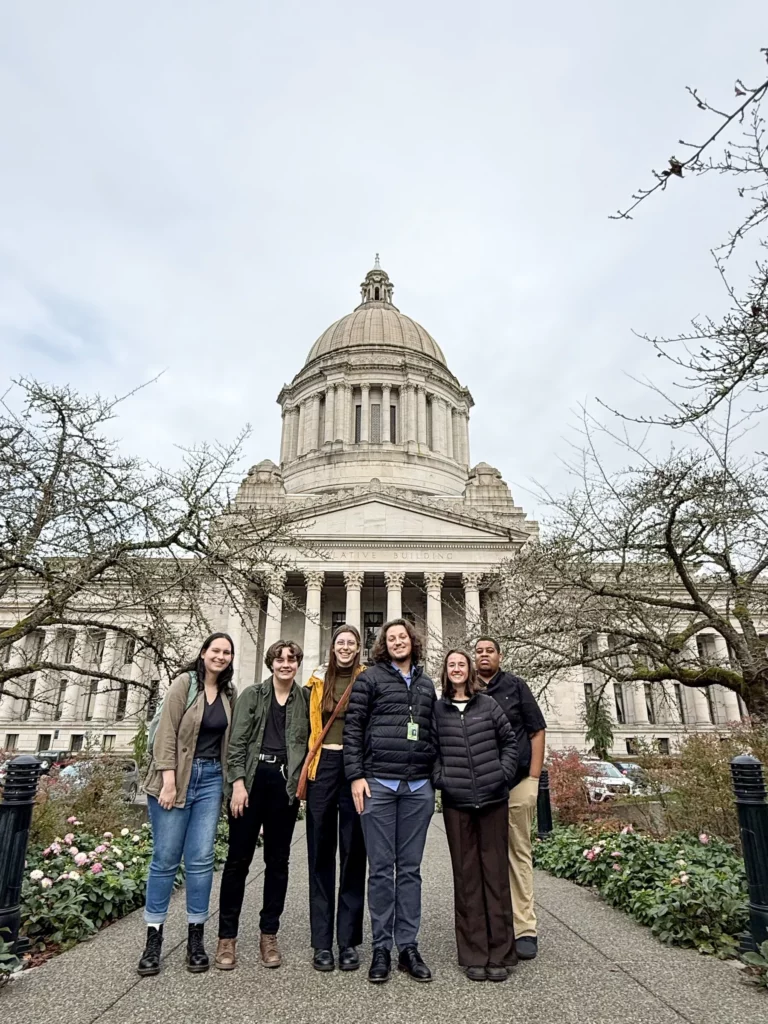
Longstanding Olympia Program Transforms Students into Frontline Reporters
For more than 50 years, UW Communication has offered students an unparalleled opportunity to step out of the classroom and directly into the fast-paced world of state politics. The State Government Communication Program, affectionately known as the “Olympia Program,” places undergraduates in full-time reporting roles during the state’s winter legislative session.
Teaching Professor and Program Coordinator Andrea Otáñez, who regularly commutes to Olympia to support the group, recently published a piece with faculty colleague Caley Cook in the Seattle Times extolling the program. Otáñez notes that the students are currently a mix of excited, confident, and understandably tired.
“Covering the legislature is not easy; it’s one of the most challenging experiences offered to students,” Otáñez says. “Veterans who cover the session regularly say it’s a fire hose down there. You have to pick and choose what you want to cover. You can’t cover it all.”
To navigate this “fire hose,” the cohort relies heavily on one another and the veteran reporters full-time at the Capitol. Otáñez maintains a constant line of communication through group text, sharing published articles and fostering a deeply supportive environment where students cheer on each other’s successes.
This support is crucial given the remarkable output the program demands. While a traditional campus class might yield two or three fully reported stories a quarter, Olympia interns often have up to 15 stories under their belts by the midway point. A standard cohort can produce roughly 100 stories per session, effectively supercharging the ecosystem of legislative news in Washington state. These student journalists are tackling heavy, timely topics, from state budgets and workers’ rights to voter security and law enforcement. One student, reporting for The Seattle Medium, is examining legislation especially relevant to African American communities.
“My students are helping keep Washington state informed in ways they wouldn’t be otherwise,” Otáñez explains. “It gets at the heart of public interest communication. They are doing work on behalf of the public… bearing witness and holding those in power accountable.”
The true value of the Olympia Program lies in this hypercharged, high-stakes environment. As Otáñez points out, “The best way to learn journalism is to do journalism.”
Yet, the program is not strictly for future political reporters. The skills developed in the crucible of the Capitol –story writing, clarity, and the capacity to rapidly synthesize complex information– are highly transferable. Regardless of the path that the student chooses, public relations, marketing, or nonprofit work, for example, covering the Legislature is a significant professional boost.
For sophomores and juniors considering applying for next year’s session, Otáñez offers a passionate piece of advice.
“It is one of the most transformative, immersive experiences you can get,” she urges. “I have so many students who say, ‘I never thought I would or could do this,’ and now they say it is the most amazing thing they’ve ever done. Just try.”
To help ensure future cohorts can continue to access this immersive opportunity, we invite you to consider making a gift to support the Olympia Program. Your contribution directly sustains the next generation of frontline student reporters.