
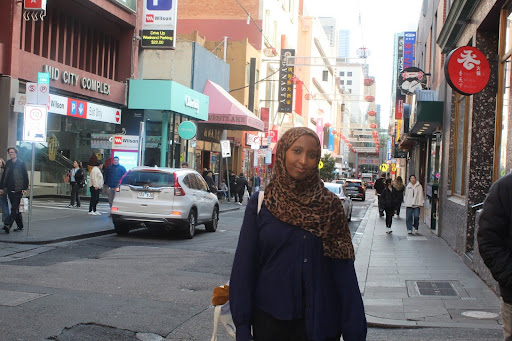
As junior Jehan Hashi snorkeled through the Great Barrier Reef, passing endless coral and sea life, she felt one thing: awe.
But she wouldn’t have been there without the opportunity to study abroad.
“It really does expand your worldview and make you realize that the communities you are in are very small relative to the world,” Hashi said.
Hashi, who is majoring in Communication and minoring in Business and Entrepreneurship, participated in the Business Australia: Business, Government, and Society program offered at the University of Washington, which took her to Melbourne, Sydney, Cairns, and Brisbane.
Hashi’s program focused on business field work, including company visits, cultural activities, and trips to nonprofit organizations like Orange Sky Laundry, a free mobile laundry service for people experiencing homelessness. The opportunities offered by UW’s study abroad programs allow students to take their learning into their own hands, introducing them to life in the field, Hashi said.
“[We were] really learning about how different countries sort of maintain the relationship between businesses and government,” Hashi said. “It was a little unique, because it wasn’t really like a class that we were doing.”
UW sends roughly 3,000 students abroad annually, with hundreds coming from the Department of Communication. Through its programs in Rome, Italy and León, Spain, the Department encourages students to go abroad, aligning with the UW’s commitment to broadening perspectives by engaging with the diversity of the world.
Hashi saw this in her own cohort, she said. They met with Michael Dezuanni, Professor of Communication at Queensland University of Technology, who gave a speech about the social media ban for people under the age of 16 in Australia that will be implemented in December 2025.
“It was really interesting to hear it from a communication perspective,” Hashi said. “His sort of academic background is doing research about how social media can impact learning and education, and how social media can almost be leveraged as a communication educational tool.”
For other students, studying abroad meant boots-on-the-ground journalism in a new country.
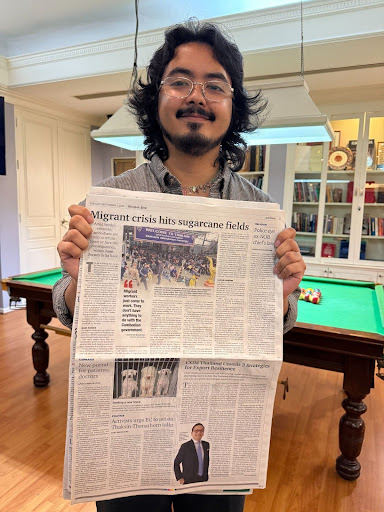
Juan Jocom, a recent graduate of Communication’s Journalism and Public Interest Communication program, spent 12 weeks in Bangkok, Thailand working for The Bangkok Post.
“Thai people read the news differently and absorb the news differently,” Jocom said. “Versus Westerners, they care about different things. They worry about different things. And what is important in the United States might not be important to the Thai community.”
Jocom participated in the Foreign Intrigue International Reporting program, a scholarship program offered by the Department of Communication for journalism majors allowing them to work as intern reporters at news outlets in developing or emerging countries. This scholarship was established by a UW Journalism alumna and exposes students to cultures significantly different from their own, helping them to develop their comprehension of foreign affairs.
Jocom, who is from the Phillipines, said that “Coming back through the department’s program, I was able to experience Southeast Asia in a way that I was able to access a lot more things where I wasn’t able to previously.,” Jocom, who is originally from the Philippines, said.
While at The Bangkok Post, he covered News and Life, including a piece on the border of Cambodia and Thailand during the 2025 Cambodian-Thai border crisis.
“I went there via permission of my editor and my advisor,” Jocom said. “It is a story about a farmer and how his life has changed since the war broke out and how this whole war has caused an immigration crisis.”
Jocom, like Hashi, mentioned that it was exposure to other cultures that changed the way they see communication processes.
“Journalism is not [just] in Seattle,” Jocom said. “It’s all around the world.”
To learn more about international internships for students, visit our website. If you’d like to support this valuable program, please visit our giving page, and search “Journalism Foreign Intrigue Scholarship.”
By Laney Jordan